Follow the Money: How Jersey Village Raises and Spends $27M
Budgets are hard to read. Line items run for pages, funds cross-reference each other, and the number that matters — where does my money actually go? — never sits on a single page.
So here is the whole General Fund in one picture. The proposed FY2027 General Fund is $26,682,411. Every dollar on the left is a source of money; every dollar on the right is something the City buys with it. The width of each flow is proportional to the dollars.
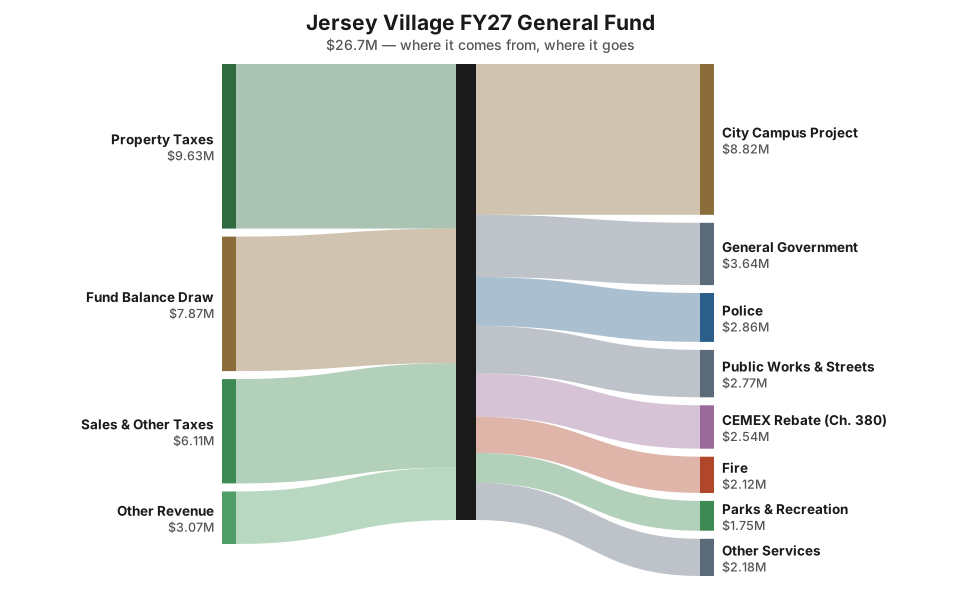
The money coming in
Recurring General Fund revenue for FY2027 is budgeted at $18,809,349. Two sources do most of the work:
| Source | FY27 Budget | Share |
|---|---|---|
| Property Taxes | $9,629,994 | 51% |
| Sales & Other Taxes | $6,105,745 | 32% |
| Fines & Court | $797,600 | 4% |
| Charges for Services | $602,060 | 3% |
| Licenses & Permits | $417,150 | 2% |
| Interest & Other | $477,100 | 3% |
| Interfund Transfers | $779,700 | 4% |
| Recurring revenue | $18,809,349 | 100% |
Property tax and sales tax together are 83 cents of every recurring dollar. That is worth sitting with: when people debate "the tax rate," they are debating roughly half the City's operating money. The other big lever, sales tax, is largely out of the City's hands — it rises and falls with what gets sold inside city limits (and, right now, with elevated CEMEX activity under the Chapter 380 economic-development agreement).
The eighth source: spending savings
There is one flow on the left that is not a tax at all — the $7,873,062 Fund Balance Draw. This is the City spending down its savings. Almost all of it — $8,823,000 in transfers out, offset by recurring surplus — funds Phase I of the City Campus project, a one-time capital commitment the City has deferred for roughly 40 years. It is not a recurring hole in the budget; it is a planned, one-time use of reserves for a one-time building project.
Strip that draw and the one-time capital transfer back out, and the City's recurring operating base is $17,859,411 — the number that actually has to balance year after year.
The money going out
| Where it goes | FY27 Budget | Share |
|---|---|---|
| City Campus Project (one-time capital) | $8,823,000 | 33% |
| General Government | $3,643,173 | 14% |
| Police | $2,859,076 | 11% |
| CEMEX Rebate (Chapter 380) | $2,538,380 | 10% |
| Public Works & Streets | $2,773,217 | 10% |
| Fire | $2,122,104 | 8% |
| Parks & Recreation | $1,745,255 | 7% |
| Dispatch | $1,117,957 | 4% |
| Community Development | $651,041 | 2% |
| Municipal Court | $409,209 | 2% |
| Total | $26,682,411 | 100% |
The single biggest slice is the City Campus capital transfer — but remember, that is the one-time reserve draw, not something the tax rate pays for every year. On a recurring basis, the story is different.
Public safety is the real recurring cost. Police, Fire, Dispatch, and Municipal Court add up to $6,508,346 out of the General Fund — and that is only the General Fund's share. Two dedicated districts (Crime Control and Fire Control) pay for nearly half of total police and fire costs. That structure is its own story, and it is the subject of the next article: Who Really Pays for Police & Fire.
A note on scope
This picture is the General Fund only — the fund that covers most day-to-day city services. Jersey Village's all-funds budget is much larger ($111,786,594), but that figure folds in bond proceeds, utility operations, and capital construction that pass through on their way to specific projects. Showing all of it in one diagram would bury the part residents actually fund with their tax and sales-tax dollars. So this is the operating picture, told cleanly.
Source: City of Jersey Village FY2026-2027 Proposed Budget, filed with the City Secretary July 1, 2026. Figures are proposed and subject to change through the public hearing and adoption process in August 2026.